
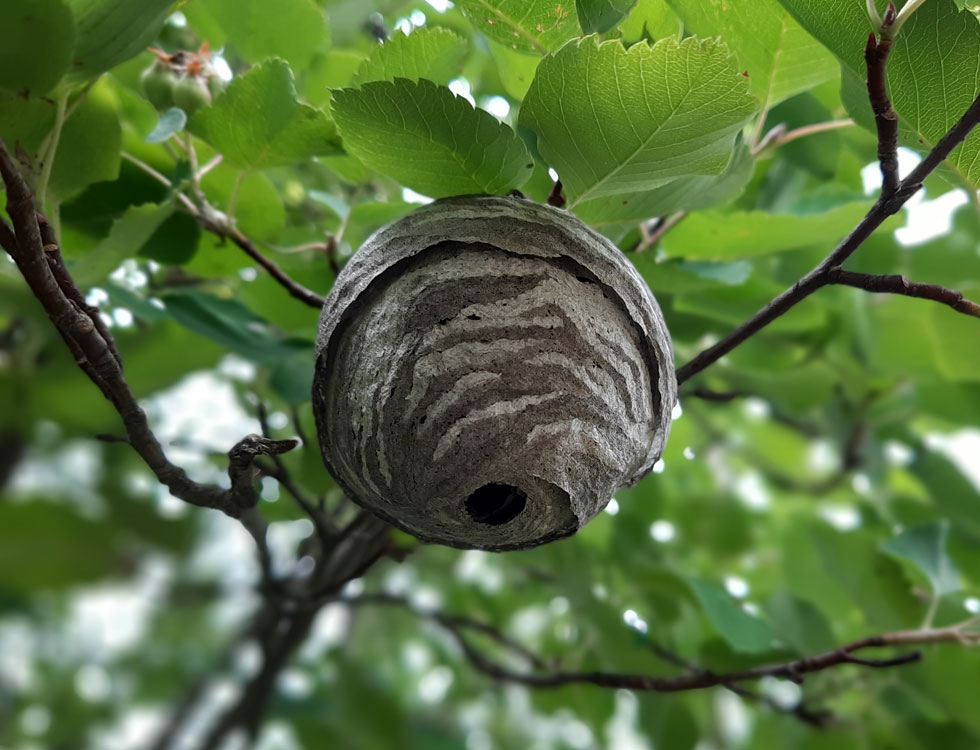
Finding a wasp nest allows you to locate it before the colony becomes too large. Learn to recognize it early on in the season and to detect the signs of its presence.
Do you suspect that wasps might be present on or around your property? Don’t hesitate to call a wasp exterminator to get rid of it safely.
Why should a wasp nest be detected rapidly?
Quick detection of a wasp nest allows you to do something about it while the nest is still small and easy to eliminate. In fact, wasps often take up residence in discreet places so as to build their nest away from prying eyes. As a result, the nest will go unnoticed for weeks, grow larger and pose an ever-increasing risk to the people nearby.
A small nest can become a problem in just a few weeks
A colony of wasps can grow fast during the summer. The heat accelerates their metabolism, and larva production increases1. Some nests, like those of the Vespula, can thus go from a few individuals to several thousand wasps in a few weeks.
When a nest begins to increase in size, more and more wasps become noticeable around the property, as there are more of them looking for food. It is not uncommon for exterminators to receive more calls about wasp nests during periods of very warm weather.
Dangers to the property’s occupants
A nest that goes unnoticed at the start of the season can eventually house thousands of wasps in August. In autumn, as the wasps have become numerous and food becomes scarcer, they can become more aggressive. If the nest is located in a high-traffic area, like near a terrace, an entryway or a playground, the risk of multiple stings increases.
According to the Association of Allergists and Immunologists of Québec, the risk of having an allergy to stinging venomous insects is around 1%. However, two types of dangers are associated with wasp stings:
- Some people who have had a skin reaction to a wasp sting in the past may develop a severe allergic reaction to a single wasp sting afterward.
- A high number of simultaneous stings (as during an attack by a swarm) can cause a toxic reaction to the venom. Children can experience a toxic response as a result of only four or five stings, even if they are not allergic to stings.
Pets are also at risk of exposure to this danger, as they can react strongly after even a single sting from a wasp.
What does a wasp nest look like when it begins?
Wasp nests look different depending on the species. The paper nest is often the easiest to recognize. When it’s starting to be built, it usually resembles a small, greyish paper ball. At the start of the season, it won’t be larger than a golf ball.
Depending on the stage of its development, sometimes the nest’s exterior shell is not present. In such a case, by looking underneath, it is possible to observe the cells that will compose the nest. For that matter, some nests maintain this open, parasol-shaped form throughout the entire season.
There are also other types of nests, such as underground nests and mud nests, which are constructed by mud-dauber wasps. The latter’s nests look like small tubes made of dried clay.
Why do small nests often go unnoticed?
Wasps seek out places that are warm, dry and undisturbed in order to establish their nest. These criteria often lead them to out-of-the-way spots where practically no one will see the nest.
Furthermore, at first, the queen cares for the nest entirely on her own, building the cells where she will lay her eggs and then feed the larvae herself. It is only three to four weeks later that the first workers will be ready to take over. But until that moment arrives, the signs that a nest is present are much less visible.
A newly started nest can, therefore, be difficult to notice in its early stages. Vigilance is nonetheless required, as this little nest will get big and fast.
What are the signs that a wasp nest is present?
As we saw earlier, wasp nests can be discreet in the beginning. Here are some clear signs that can alert you and should be monitored:
- Wasps frequently coming and going
- A repetitive trajectory toward the same place
- Activity that focuses around the same opening
- Regular presence of several wasps at the same location
- Perceptible humming or buzzing sound near a structure
If you notice even one of these signs, inspect the surrounding areas to try to locate the nest. If in doubt or if you’re not comfortable with the situation, contact an exterminator. It’s always preferable to act early in the season, while the nest is still small and easier to deal with.
The top 5 places to look for a wasp nest on or around your property
Once you’ve noticed signs of wasp activity, you can start by conducting a visual inspection of the most likely places the nest might be. Here are the 5 areas to inspect primarily:
- Under eaves/roof overhangs and soffits: these hidden areas protect wasps from wind and rain. Also inspect gutters and corner fittings of the roof.
- Under terraces and balconies: wasps can infiltrate these structures in order to build their nests under the boards.
- In sheds: the ceilings and frames/structures of sheds offer excellent shelter for wasps.
- In hedges and trees: wasps can nest inside a branch, a hollow tree trunk or a dense hedge without anyone noticing.
- In the ground: some wasps build their nests by digging underground. Look for a circular hole that’s about 2 cm to 4 cm (0.75 in – 1.5 in) in diameter, surrounded by a small quantity of fresh dirt and where wasps regularly go in and out.
- Inside a wall: wasps can also crawl into tiny spaces in brick or exterior cladding to build a nest that will remain well hidden within a wall or overhang.
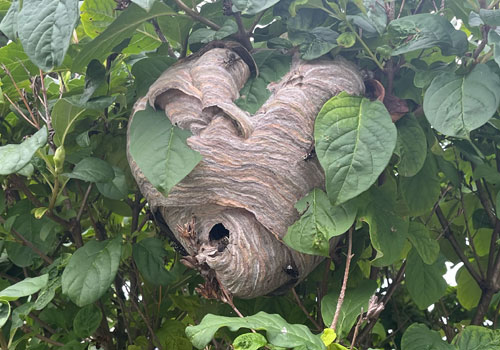
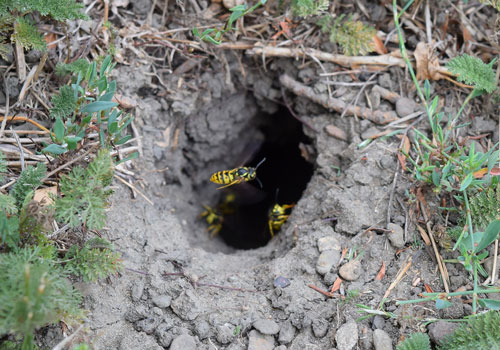
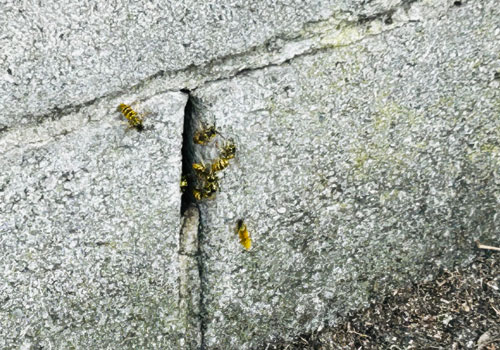
If you have noticed signs of wasp presence but haven’t found the nest, you can try to follow the wasps’ activities. This should guide you to their nest.
How to follow wasp activity in order to locate their nest
To locate a nest, you can follow the wasps’ activities. Here are a few tips to do this safely:
- Make your observations early in the morning or at the end of the afternoon, between 4 p.m. and 7 p.m., when the wasps are returning to the nest at the end of the day.
- Observe the wasps’ trajectory. A wasp returning to its nest flies in a straight line, whereas a wasp searching for food flies more slowly and often changes direction.
- Look out for repetitive comings and goings toward the same point.
- Note the zones where several wasps converge; this is a good indicator that a nest is nearby.
- Keep a safe distance of at least 5 metres (15 feet) away from the nest. It is also recommended to avoid moving around while you’re conducting your observation.
If the observed trajectories all point toward the same spot, it’s very likely this is where the nest is located. However, it’s also possible the wasps are merely passing through and the nest is further out.
How far do wasps travel when searching for food?
Wasps can travel several hundred metres away from their nest in order to look for food2. Some species can travel over 500 metres. So, seeing wasps from time to time doesn’t systematically mean that a wasp nest is on your property. The nest could very well be located elsewhere in your neighbourhood or in a nearby wooded area.
However, when responding to calls by our clients in Greater Montréal and the South-Shore, our technicians report the following tendency: an elevated presence of wasps translates very often to the discovery of a nest nearby, often at a distance of 50 m (250 feet) or less. So, in many instances, all you need to do is look right around you!
Is it dangerous to leave a wasp nest where it is?
Not always. Wasps play an essential role in the environment. They help control the populations of other insects and participate in pollination. In the end, the answer depends on where the nest is situated and the degree of its activity.
Low-risk situations
For example, a nest that is far away from high-traffic areas, with little wasp activity observed, poses few risks. It’s often all right to leave the nest as it is.
High-risk situations that require rapid action
Some situations are riskier, however, notably if a wasp nest is located near:
- an entrance
- a terrace or eating area
- a playground or play area
- a business open to the public
A nest located within a wall also requires acting fast, because the wasps could find a way to enter inside the home in large numbers. Finally, a quick response is important in the case of an underground nest, as the wasps might be provoked into attacking if someone walks on it.
It is all the more crucial to act quickly if people in your surroundings are allergic to wasp stings.
What should you do if you discover a wasp nest?
Once you’ve located the nest, here are the right steps to be taken:
- Avoid approaching the nest needlessly;
- Do not attempt to move or destroy the nest yourself;
- Avoid improvised methods, like homemade traps or ill-suited products;
- Ask a professional to assess the situation.
Ask a professional exterminator to find and eliminate a wasp nest
Do you think you’ve seen a wasp nest on your property? Contact Avalanche Extermination for a prompt and safe inspection.